Abstract
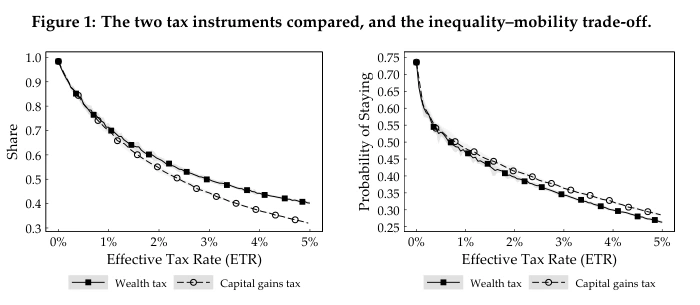
We compare wealth taxes and capital gains taxes in a random growth model with id- iosyncratic investment risk. At equal tax revenue, wealth taxes generate higher wealth inequality than capital gains taxes, and higher wealth mobility wherever growth volatility is high enough. The mechanism is variance: wealth taxes shift the mean of post-tax wealth growth and raise its variance, while capital gains taxes compress the upper tail and reduce variance. Lower variance narrows the stationary distribution, reducing wealth inequality, but slows wealth rank changes, reducing wealth mobility, and at a baseline calibration the variance effect dominates. Policymakers who value both low wealth inequality and high wealth mobility therefore face a trade-off. The trade-off is robust to type and scale de- pendence in returns, hand-to-mouth agents, aggregate risk and tax progressivity, and full deductibility of capital losses below a two percent effective tax rate