Abstract
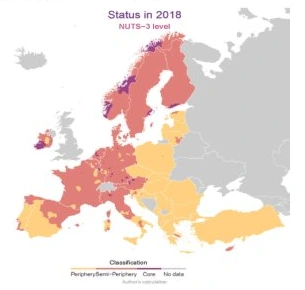
We document two novel stylized facts on European integration and cohesion. First, we show that the interregional income distribution, measured as GDP per capita at the NUTS-3 (Nomenclature des unités territoriales statistiques) level, is bimodal for all considered years. Second, we demonstrate that this mixture of two log-normal distributions provides an excellent fit for this interregional distribution in all considered years. We put forward two meso-level interpretations of these stylized facts, based on heterodox growth theory: The log-normality of the individual clusters hints at a cumulative growth process, where growth is strongly path-dependent. However, the bimodality in the income distributions also implies two separate growth mechanisms. We show that the high-variance log-normal distribution governs the dynamics at both tails of the income distribution, which might be interpreted as the core and periphery, and the low-variance variant the bulk of the distribution, thus interpretable as a semi-periphery. Based on these theoretical mechanisms, we propose a taxonomy of European regions that is not based on arbitrary GDP thresholds