Summary
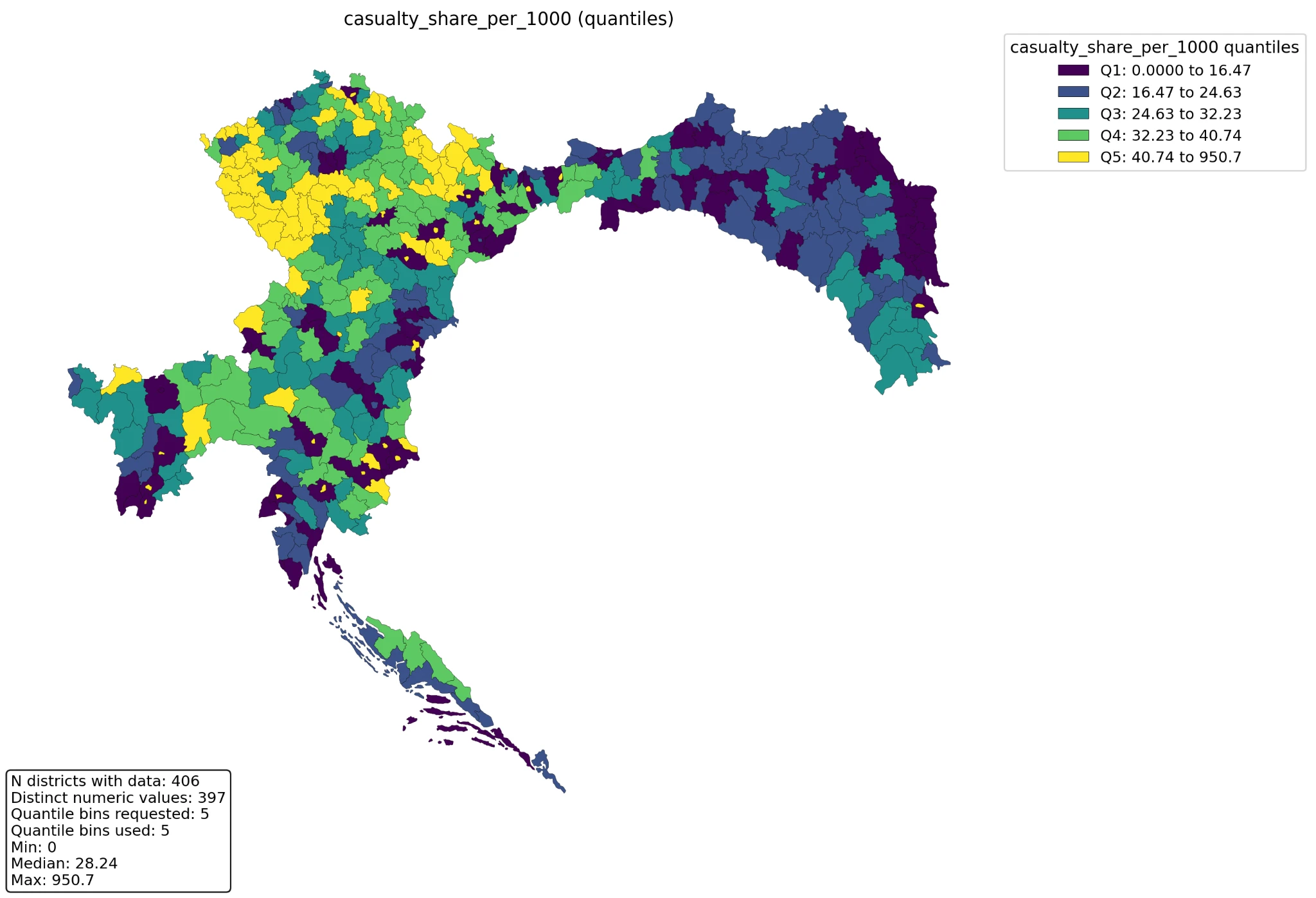
This paper asks how class and local social structure shaped the human costs of the First World War. It uses casualty lists not as transparent mirrors of battlefield mortality, but as administrative records whose class content has to be reconstructed in relation to censuses, city directories, occupational categories, and local wartime institutions. I combine district-level evidence from the Austro-Hungarian loss lists with a source-critical local pilot for Worms, and outline extensions to Leipzig and the German Reich.
Across these settings, the evidence does not support a simple monotonic story in which either “the poor died more” or “the elites were protected.” In Cisleithania, baseline status measures are associated with higher casualty incidence but lower conditional lethality. Once public-service and military-administrative structure is separated from socioeconomic status, broad and non-officer incidence gradients turn negative, while officer incidence remains strongly positive. In Worms, industrial and unskilled workers appear roughly proportional to their address-book share, whereas the most robust excess is concentrated among skilled craft and building occupations; official/professional and transport/railway groups are underrepresented.
The common pattern is a layered political economy of war losses. Class mattered, but through institutional and occupational mechanisms: officer recruitment, military administration, manpower allocation, sectoral protection from mobilization, and the military usability of particular forms of skilled labor. The project therefore treats casualty lists as sources for studying inequality in the social organization of military risk, while remaining attentive to source artifacts, occupational labeling, and the distinction between casualty incidence and conditional lethality.
Currently, we are extending the analysis to the full list for the German Reich and a more granular analysis of the city of Nuremberg.