Abstract
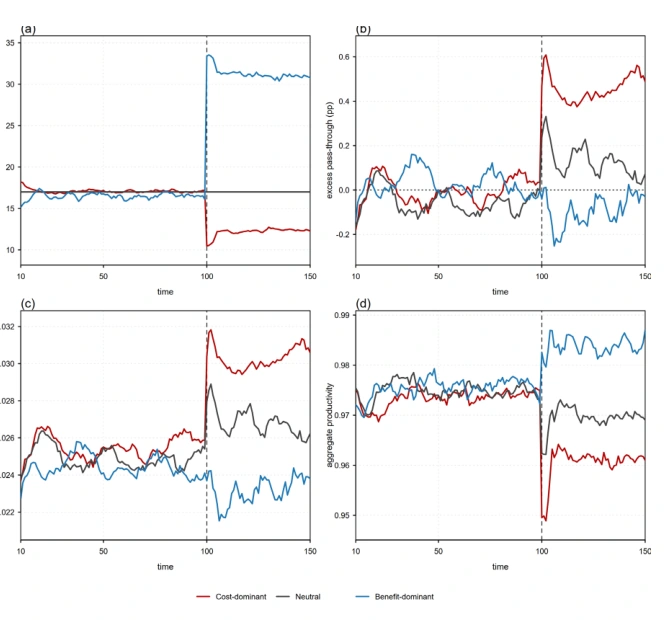
The relationship between firm markups and inflation remains contested. We develop a demand- side explanation for markup dynamics in times of inflation that distinguishes two opposing effects of price dispersion on consumer search. Higher dispersion can raise the cost of comparing sellers, but it can also raise the inclusive-value benefit of searching more broadly because low-price options become more valuable. We develop a two-stage random-utility formulation that yields cost- dominant, neutral, and benefit-dominant search regimes. Depending on which channel dominates, consumers’ consideration sets shrink or grow following an increase in price dispersion. We embed these regimes in an agent-based model with heterogeneous firms, variable markups, and firm- specific exit tolerance. Following a heterogeneous cost shock, sellers’ inflation—operationalized as an excess pass-through of an input cost shock to output prices—emerges in the cost-dominant and, more moderately, in the neutral regime, but disappears or reverses when the benefit channel expands consideration sets. The benefit-dominant regime also generates the highest aggregate productivity and market concentration, while markups and profits are lowest. Concentration is therefore benign in this regime: it reflects stronger selection toward productive, low-price firms rather than greater discretionary pricing power. The model consequently provides a microfoundation for why concentration, market power, and allocative efficiency need not move together during cost shocks