Abstract
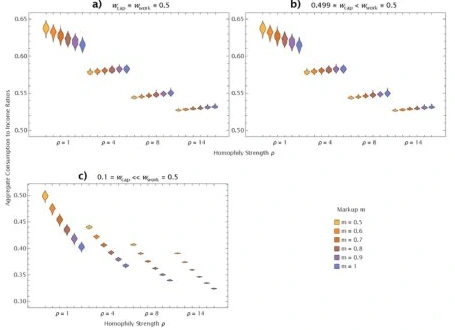
Personal income distributions robustly follow a two-class structure, with an exponential bulk of labour income accruing to the lower 95 - 99 % population share and an upper Pareto tail of the 1 - 5% richest, where capital income is concentrated. The implications of this regularity for macroeconomic outcomes, especially aggregate consumption, are not yet fully understood, though. We introduce this two-class structure into a Post-Keynesian consumption model with workers and capitalists corresponding to the two classes within the personal distribution. Agents consume according to idiosyncratic and social motives. Status consumption is microfounded within a perception network that replicates empirically observed inequality and social self-perceptions. Our findings indicate that the non-market interactions in perception networks are potentially highly relevant for aggregate outcomes and that they can shed some light on recent puzzles in the Post-Keynesian literature on growth regimes. In particular, we show how network segregation can explain differences in the degree of ‘wage-ledness’ of aggregate consumption. Aggregate representations of consumption might thus be misleading. Empirical studies should therefore take the regularities both in the income distribution as well as social network topologies into account. ARTICLE HISTORY Received 27 April 2023 Accepted 13 December 2023