Abstract
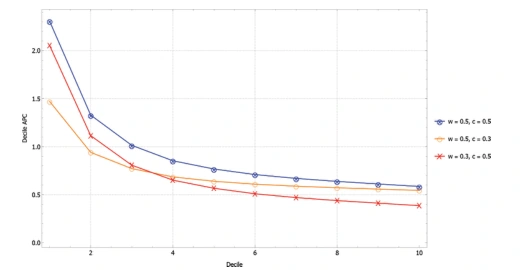
The nexus between debt and inequality has attracted considerable scholarly attention in the wake of the global financial crisis. One prominent candidate to explain the co-evolution of income inequality and private debt has been upward-looking consumption externalities leading to expenditure cascades. We propose a parsimonious model of upward-looking consumption at the micro level mediated by perception networks with empirically plausible topologies. The model, based purely on current income, replicates major stylised facts of micro consumption behaviour and is observationally equivalent to the workhorse permanent-income hypothesis without facing its dual problem of excess smoothness and excess sensitivity. We also show that network topology and segregation have a significant effect on consumption patterns that has so far been neglected.