Abstract
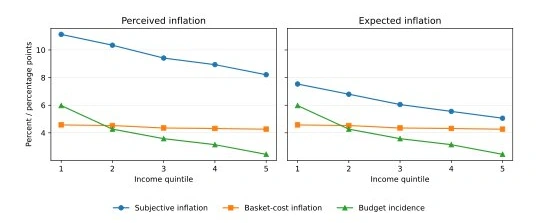
Lower-income households systematically report higher perceived and expected inflation, even though household-specific basket inflation varies little across income groups. We propose budget-weighted inflation, which measures the increase in the cost of a fixed consumption basket relative to current income, as a proxy for the material pressure of inflation on household resources. Using microdata for ten euro-area countries, we show that budget-weighted inflation closely reproduces the income gradient in inflation perceptions and expectations, unlike conventional household-specific inflation measures. The result is robust across alternative specifications and supported by household-level evidence linking tighter budget commitments to higher inflation reports and stronger adjustment to price changes.