Abstract
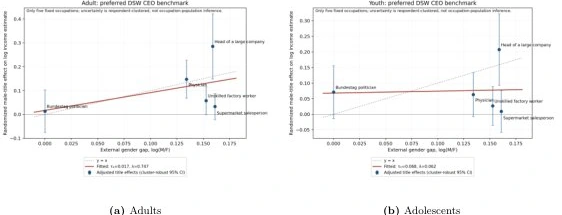
We study whether gender enters beliefs about the economic returns associated with occupa- tions. Adults and adolescents in Germany were randomly assigned to estimate the earnings of five occupations presented with either masculine or feminine titles. Masculine titles raise perceived pay by 11.3 percent among adults and 7.9 percent among adolescents. Among adults the effect is similar for male and female respondents; among adolescents it is approximately zero for boys and 16.1 percent for girls. Title effects also vary sharply across occupations. We benchmark this heterogeneity against occupation-specific male–female pay differences from administrative earnings data and a DAX CEO compensation study. Actual gaps are positively aligned with adult title effects but cannot account for their occupational pattern: occupations with nearly identical observed gender gaps generate radically different experimental responses. The results imply that gender is part of the prior people attach to the economic value of an occupation rather than merely a reflection of known wage differences. They also have a measurement implication: the linguistic form used to elicit labor-market beliefs can materially change the beliefs researchers observe. 1