Abstract
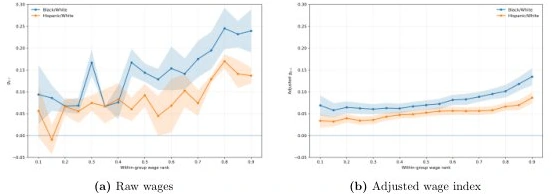
Research on intersectional wage gaps usually asks whether workers who combine marginalised identities face a wage penalty beyond the separate penalties associated with each identity. We examine the same nonadditivity from the opposite corner of the wage structure and ask how it relates to aggregate wage inequality. Using 26.5 million observa- tions from the 1980–2024 U.S. Census and American Community Survey, we construct a no-interaction wage benchmark for White men from the observed wages of White women, Black or Hispanic men, and Black or Hispanic women. The resulting White-male premium is positive over almost the full wage distribution, particularly at higher wage ranks, and remains economically significant after conditioning on worker and job characteristics. Removing this interaction lowers the Gini coefficient of the complete eligible-worker distribution by about 3 per cent. Redistributing the excess privilege to the other groups leads to substantially larger reductions. The results connect intersectional wage structure to aggregate inequality and highlight the distributional role of multiply advantaged groups