Summary
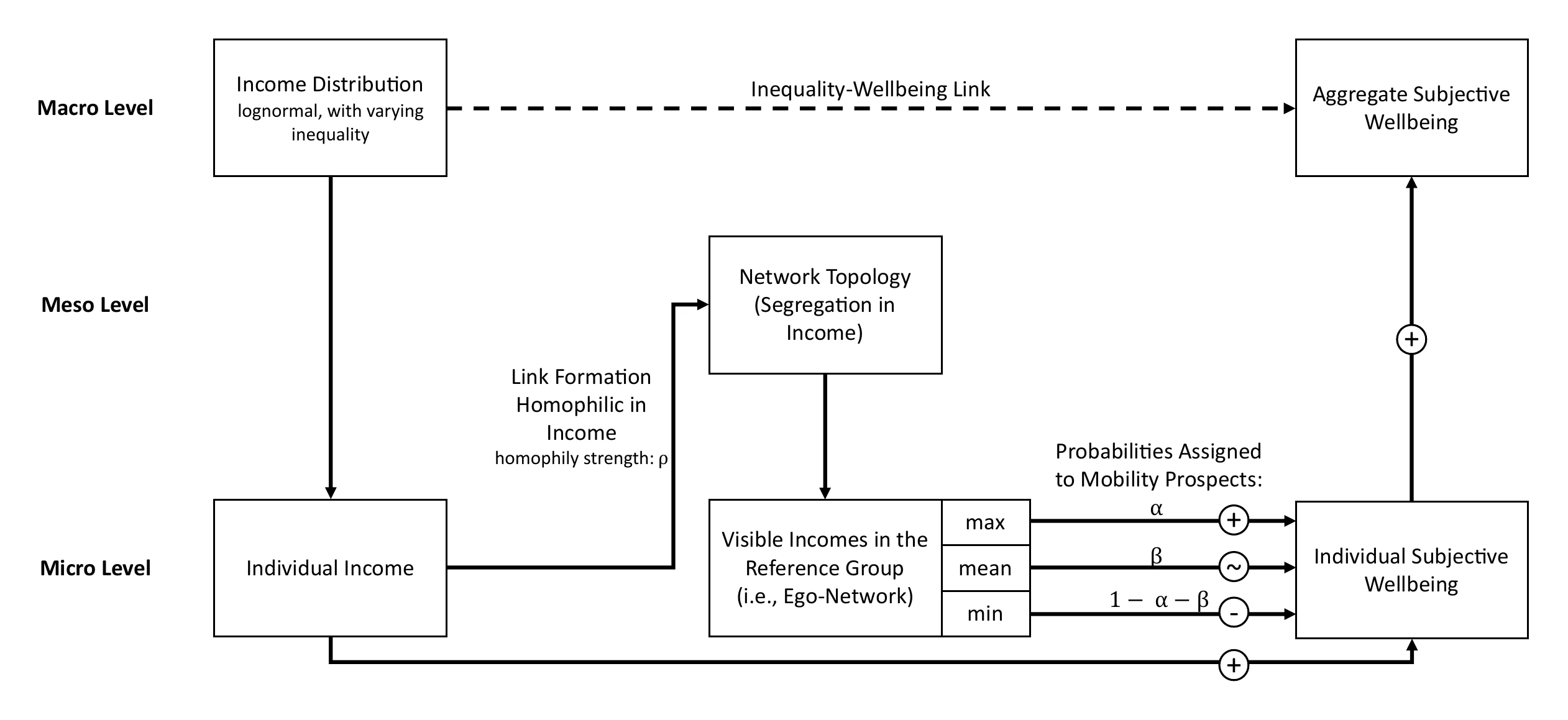
Empirical findings on the relationship between income inequality and subjective wellbeing are heterogenous, finding negative, positive, and inverted U-shaped relationships as well as insignificance. This study returns to this puzzle by taking two basic insights from Hirschman and Rothschild's tunnel argument as a point of departure: individuals use socially visible economic positions to form beliefs about their own prospects, and the relevant field of observation is locally bounded. We embed these insights in a model of localised inequality perceptions in an income-homophilic social network. The model generates qualitative counterparts of the positive, negative, inverted U-shaped, and null relationships documented in the empirical literature. Most importantly, it provides a complementary mechanism for the inverted U: the reversal can emerge from the interaction of mobility beliefs and social segregation, without assuming a subsequent switch from optimism to frustration. We demonstrate that in homophilic networks, the relationship can become highly nonlinear. Our simulation results thus offer a cautionary tale against the pitfalls of generalising from local observed behaviour both for policy and empirical estimation.