Abstract
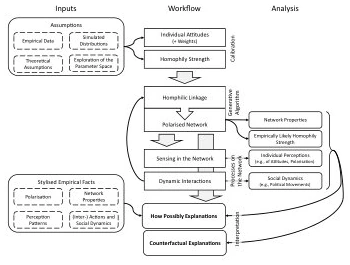
This paper presents a generative algorithm for simulating network polarisation based on attitudinal homophily, i.e., the tendency to connect to others with similar attitudes as oneself. To do so, it applies the notion of preferential attachment to node properties other than degree, aiding intuitive communication within and beyond the network science community. The algorithm works with one or more flexibly weighted attitude dimensions, heterogeneous populations. The generated networks commonly share features of real-world social networks such as (weak) small-worldiness. They can contribute to how- possibly explanations of stylised empirical facts, especially when empirical network data is missing. An example on polarisation in Germany on migration attitudes is used to illustrate this. We find that homophily can generate patterns resembling empirically reported polarisation and individual perceptions, such as viewing one’s own opinion as moderate, over-estimating the actual level of societal polarisation, and dwindling open-mindedness towards others with different attitudes.