Summary
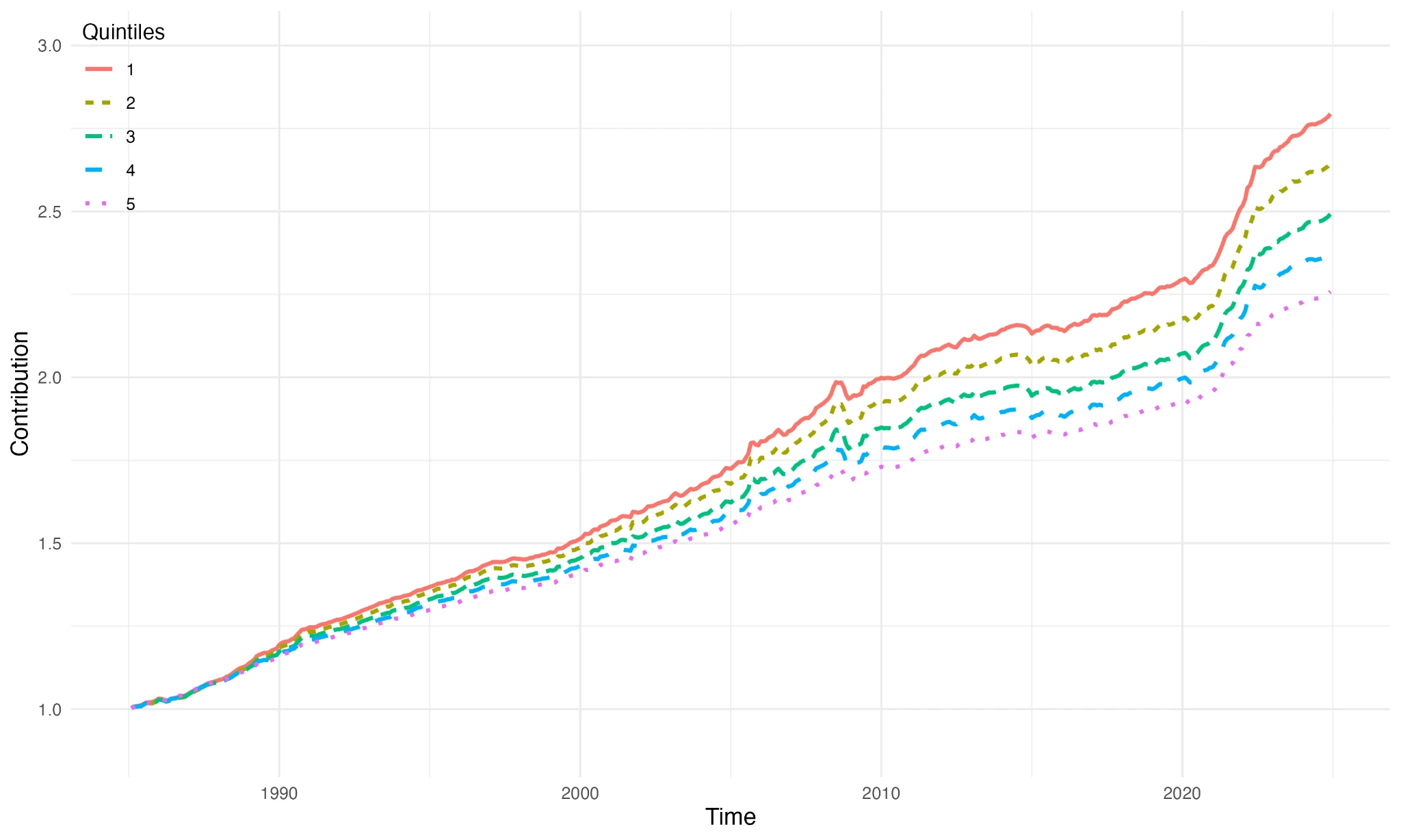
Inflation does not affect households uniformly, and the recent inflation surge was no exception. While research on inflation inequality is expanding, identifying its triggers and channels remains a paramount challenge. In this paper we address this challenge by providing a comprehensive analysis of income dependent inflation exposure to supply and demand shocks. We link monthly quantity and price data to income-specific consumption shares across more than 55 categories for U.S. households from 1970 to 2025. Using the sign-restriction approach of Shapiro (2022), we identify supply and demand shocks at the CPI-category level and compare the resulting exposure across five income quintiles. Our preliminary findings reveal that relative exposure to supply and demand shocks varies substantially over time and exhibits cyclical patterns. Three main results emerge. First, lower-income households tend to be disproportionately affected by volatility in both supply- and demand-shocks. Second, since the early 2000s, the exposure of lower-income households to supply shocks appears to have increased systematically. Third, during the most recent inflationary episode, lower-income households were disproportionately affected by both demand- and supply-driven price changes. Taken together, these results suggest that in the current environment monetary policy might play a role in reducing income dependent inflation inequality – limited however by the prevalence of supply shocks.